TwinEdge AssetOps EAM
Physics-grounded AssetOps EAM for connected maintenance, reliability, and field operations.
AssetOps EAM brings asset records, telemetry, GIS, physics-based digital twins, process context, failure analysis, predictive maintenance, O&M/EOM knowledge, PMs, work orders, rounds, inventory, parts, BOM, procurement, resource planning, route optimization, ERP integrations, dashboards, and governed AI recommendations into one operating layer.
Asset intelligence
GIS and routes
Physics-based twins
Failure analysis
Predictive PM
ERP-ready execution
AssetOps is a physics-grounded maintenance suite, not a conventional ticketing CMMS.
Platform in action
Physics-grounded AssetOps EAM for maintenance, reliability, GIS, O&M, and field execution
AssetOps brings operations navigation, asset registry, physics-driven insights, AI PM recommendations, O&M chat with citations, electronic operations manuals, rounds, inventory, BOM, procurement, GIS, route optimization, and ERP-ready execution into one suite.

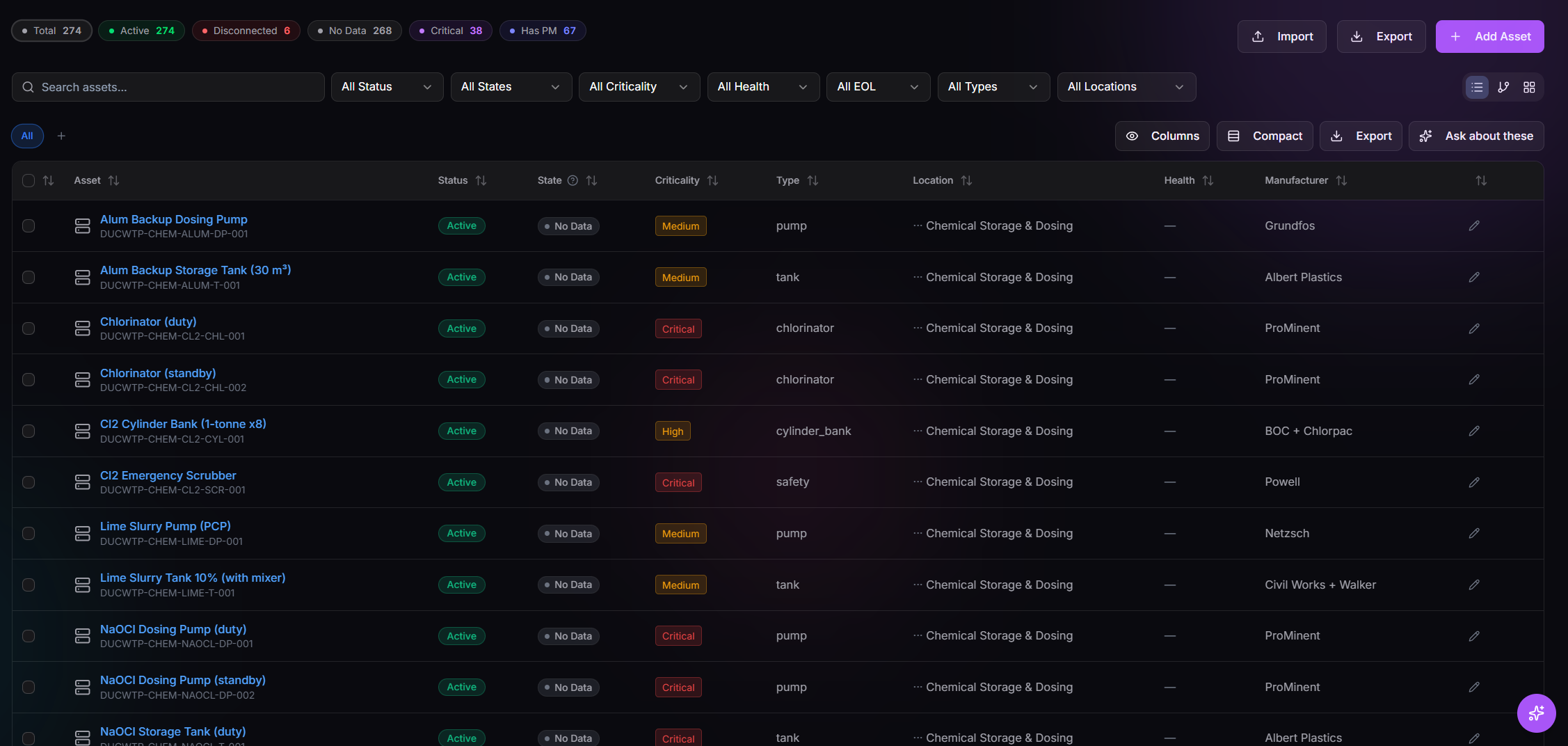
Asset registry and hierarchy
The asset registry organizes equipment, location, health, criticality, work context, PM status, GIS links, network relationships, documents, and operational actions in one workspace.

PM recommendations from O&M manuals
AI-extracted PM recommendations carry source document, cadence, priority, confidence, physics context, and approval state before becoming schedules.

Network tracing and GIS context
Spatial and network views connect assets, pipes, valves, isolation paths, telemetry, work, and compliance context before a planner dispatches field work.

O&M chat with citations
Planners and technicians can ask manual questions and see cited answers with page references.

Electronic operations manual
EOM surfaces procedures, drawings, P&IDs, execution evidence, and training/compliance context.

Inventory and storeroom control
Inventory views expose stock status, reorder signals, storeroom context, reservations, costs, and parts availability for work planning.

Inspection protocols
Inspection templates and protocols standardize field checks, safety steps, measurements, evidence requirements, and completion readiness.

Purchase orders and receiving
Procurement screens connect purchase orders, vendors, line items, approvals, receiving status, costs, and asset or inventory updates.

Warranty management
Warranty views keep equipment coverage, terms, claims, expirations, vendors, documents, and recoverable value visible before work is approved.

PM scheduler, forecaster, and optimizer
The PM scheduler compares forecasted workload, crew capacity, optimization candidates, conflicts, and recommended schedule adjustments.

Capacity forecast
Capacity forecasting shows future workload, crew demand, backlog risk, available capacity, and planning windows for preventive maintenance.
Workflow
From physics-based asset context to maintenance action
Connect industrial sources, build trusted context, govern recommendations, and turn approved decisions into operational work.
Unify the asset and process model
Bring hierarchy, GIS, network position, telemetry, sensors, documents, O&M, physics-based twin state, operating envelopes, warranty, BOM, inventory, and lifecycle context into one asset view.
Diagnose and predict before dispatch
Use failure modes, operating-envelope deviation, RUL forecasts, deterioration, vibration, O&M extraction, skill constraints, parts availability, route distance, rounds, weather, and custom telemetry to propose work with confidence and evidence.
Approve, execute, and learn
Planner approval creates PM schedules or work orders, reserves parts, routes field work, syncs with SAP, Oracle, Microsoft Dynamics, ERP/EAM, or external systems, updates dashboards, and feeds closeout evidence back into future physics-informed recommendations.
Capabilities
AssetOps capabilities
Connected asset intelligence
Asset registry, hierarchy, GIS, network tracing, datasheets, telemetry, sensors, physics-based digital twins, process context, health, deterioration, lifecycle, and warranty context.
Physics-based failure analysis
Operating envelopes, first-principles models, performance curves, affected sensors, likely failure modes, process impact, and source evidence stay tied to the asset and work decision.
Preventive and predictive maintenance
PM schedules, templates, programs, inspection protocols, O&M-derived PM recommendations, and predictive proposals from RUL, physics-based degradation, vibration, operating load, and custom telemetry sources.
Electronic knowledge to action
Vendor O&M ingestion, RAG chat with citations, PM extraction, electronic operations manuals, procedures, drawings, P&IDs, executions, training plans, and compliance evidence.
Work, workforce, and field optimization
Work orders, assignments, approvals, scheduling boards, resource planning, AI planner optimization, route optimization, rounds, crews, shift management, on-call, qualifications, travel matrix, weather gating, morning briefs, and mobile diagnostics.
Reliability, inventory, safety, and procurement
Reliability Autopilot, bad actors, FMEA, Pareto, RCA, Weibull, BOM, parts, inventory, storerooms, procurement, purchase orders, requisitions, receiving, van stock, vendors, warranties, permits, incidents, e-signatures, controls, and audit packages.
Configurable, governed, and integration-ready
Custom fields, form designer, form templates, workflows, workflow gates, field policies, business rules, roles, field permissions, scoped access, AI governance, audit, dashboards, Superset BI integration when enabled, and governed integration with SAP, ERP, Oracle, Microsoft Dynamics, or other external systems.
Asset detail
An asset record that understands physics, condition, and process impact
Each asset becomes an operational context hub with telemetry, physics-based twin state, operating envelopes, documents, maintenance, reliability, and field history.
Digital twin and physics context
Asset detail includes sensors, physics-based twin state, live analytics, simulation, input mappings, equations, correction factors, condition, deterioration, and health.
Failure mode and process context
Failure analysis connects affected sensors, likely causes, operating-envelope deviation, process impact, recommended response, and source evidence.
Maintenance and material context
PM, maintenance, O&M, documents, diagnostics, knowledge, warranty, network, lifecycle, BOM, parts, inventory, procurement history, reliability, and agentic analytics are part of the asset view.
Spatial and route context
AssetOps GIS links assets, telemetry, work, PM inspections, rounds, compliance zones, documents, alarms, service areas, route optimization, and network traces.
Governance
Configurable enterprise operations without hard overclaims
Enterprise controls adapt AssetOps to local operating practice while keeping permissions, validation, and auditability clear.
Custom fields and forms
Tenant-defined custom fields and form templates adapt AssetOps to local operating practice. Custom values are flexible JSONB-backed data with validation rules and practical platform limits, not a literal unlimited promise.
Roles, scopes, and field permissions
Entity permissions, field permissions, hierarchy/site/asset-class/equipment-type/tag scopes, identity providers, groups, delegations, audit browser, and org policies support enterprise controls.
Dashboards and BI
Custom dashboards, widgets, role-based defaults, filter context, cross-filters, pinned KPIs, and Apache Superset integration are available when BI Studio is enabled.
CMMS breadth
AI-native EAM and CMMS capability matrix
AssetOps spans the workflows maintenance and reliability teams expect, with AI-native context and governance built into the operating layer.
Engineering controls
Engineering controls for industrial AI.
TwinEdge can show real telemetry, local inference, protocol flows, and agent traces without claiming uncontrolled autonomy or SCADA replacement.
Read-only first
Physical writeback is disabled by default and recommendations pass through approval gates.
Replayable evidence
Plans, diffs, source context, and approval history remain available for review.
Deployment choice
Cloud-connected, local, and offline paths support evaluation without forcing one architecture.
Source system respect
TwinEdge works above SCADA, historians, CMMS, GIS, LIMS, ERP, and data lakes rather than pretending to replace them all.
Outcomes
Operational outcomes
Teams get the context, controls, and execution path needed to move from noisy industrial data to approved operational action.
Maintenance leaders
Move from static work queues to evidence-backed planning across PMs, physics-based condition, work orders, parts, safety, field execution, and closeout history.
Reliability teams
Use health, deterioration, physics, failure history, bad actors, RCA, Weibull, and cited knowledge next to the asset and maintenance plan.
Operations executives
See asset risk, process impact, compliance exposure, work backlog, capital implications, workforce constraints, and operational evidence in dashboards and BI.
Connected platform
Extend the same context across the operating layer
DataOps Workbench creates the physics-aware, AI-ready context.
Agentic Analytics uses that context to explain, draft, and validate recommendations.
TwinEdge OS supports cloud-connected, offline, and protocol-rich edge deployments.
AssetOps EAM and Field close the loop from recommendation to evidence-backed work.
Water, wastewater, chemical, water loss, lab, and facility products package industry workflows.
REST and MCP data products make context available to enterprise applications and AI systems.
Evaluate TwinEdge
Plan your first TwinEdge workflow.
Review the operating model with our team, or download TwinEdge to evaluate the platform in your own environment.