Observe in context
Bring telemetry, asset relationships, manuals, and service history into the finding.
Predictive analytics and AI-native agents for industrial work.
TwinEdge Agentic Analytics is AI-native. Agents read live equipment history, explain extra cost or wear, and draft the next job. A person approves.
AI-native agentic analytics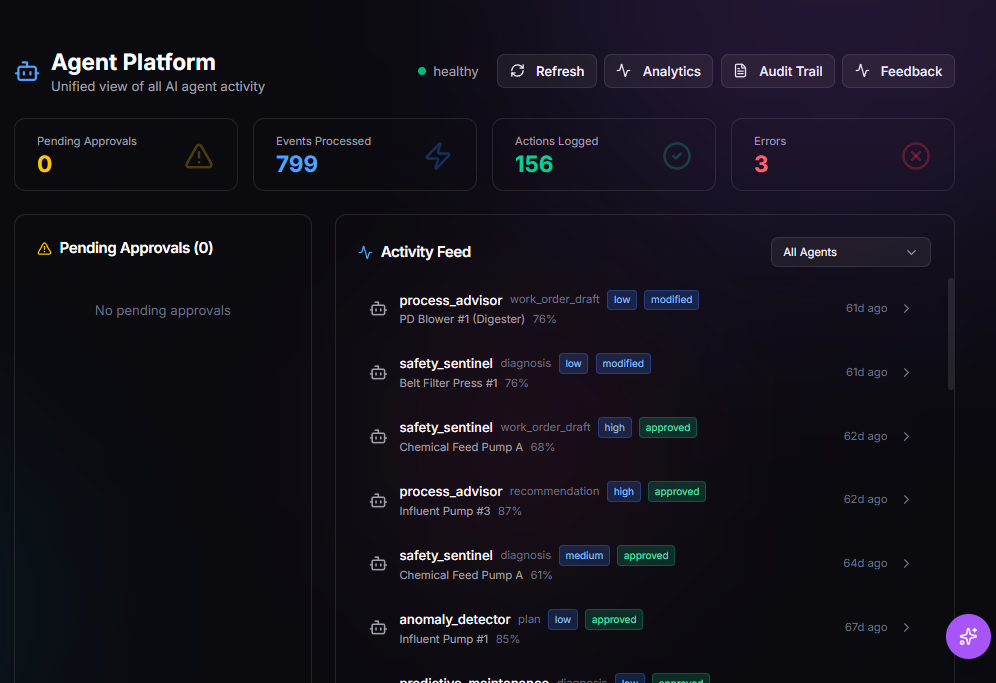
Specialist agents share one operating record — diagnostics, planner, inventory, capital, and knowledge.
Bring telemetry, asset relationships, manuals, and service history into the finding.
Diagnose the issue and prepare maintenance, inventory, or operating recommendations.
Keep the decision, work, and resulting evidence connected for the next analysis.
Evidence travels with the recommendation.
Diagnostics, maintenance, inventory, and capital agents share context.
The finding reaches the workflow that can resolve it.
Select a screen to explore the workflow. Open it for a closer look.
The agent platform brings specialist roles, findings, and pending decisions into a shared operating view.
Estimate likely wear, extra energy, and failure risk from live condition, operating history, and physics context , then attach the evidence to the asset.
Evidence-backed findings with source links, asset context, physics signals, risk, and suggested actions.
Dry-run plans, diffs, eval gates, and human review before routing work or publishing products.
REST and MCP surfaces expose governed operational context to trusted apps and AI clients.
Keep source context available as the workflow moves between teams and applications.
TwinEdge Agentic Analytics
TwinEdge predictive analytics estimates likely future equipment behavior from live condition, operating history, physics models, and work records. Agentic Analytics turns that estimate into an explainable finding and a drafted next step for a person to approve.
A TwinEdge industrial AI agent works inside a bounded operational task. It reads approved asset and process context, explains evidence, drafts a recommendation or work package, validates policy, and records the result for replay.
General chat starts from a prompt. TwinEdge starts from governed industrial context, physics outputs, source lineage, tools, roles, approval rules, and a defined operational handoff.
No. TwinEdge is recommendation-first and read-only by default. Agents can draft and validate proposed actions, but a human approval gate controls operational handoff unless a separately governed policy explicitly permits more.
Recommendations can retain source records, asset context, physics and quality signals, assumptions, dry-run output, approval history, work handoff, and final closeout evidence.
Approved applications and agents can use tenant-scoped REST APIs and MCP tools that expose governed operational context without granting unrestricted access to source systems.
Discuss your sources, assets, and the outcomes your team wants to improve.