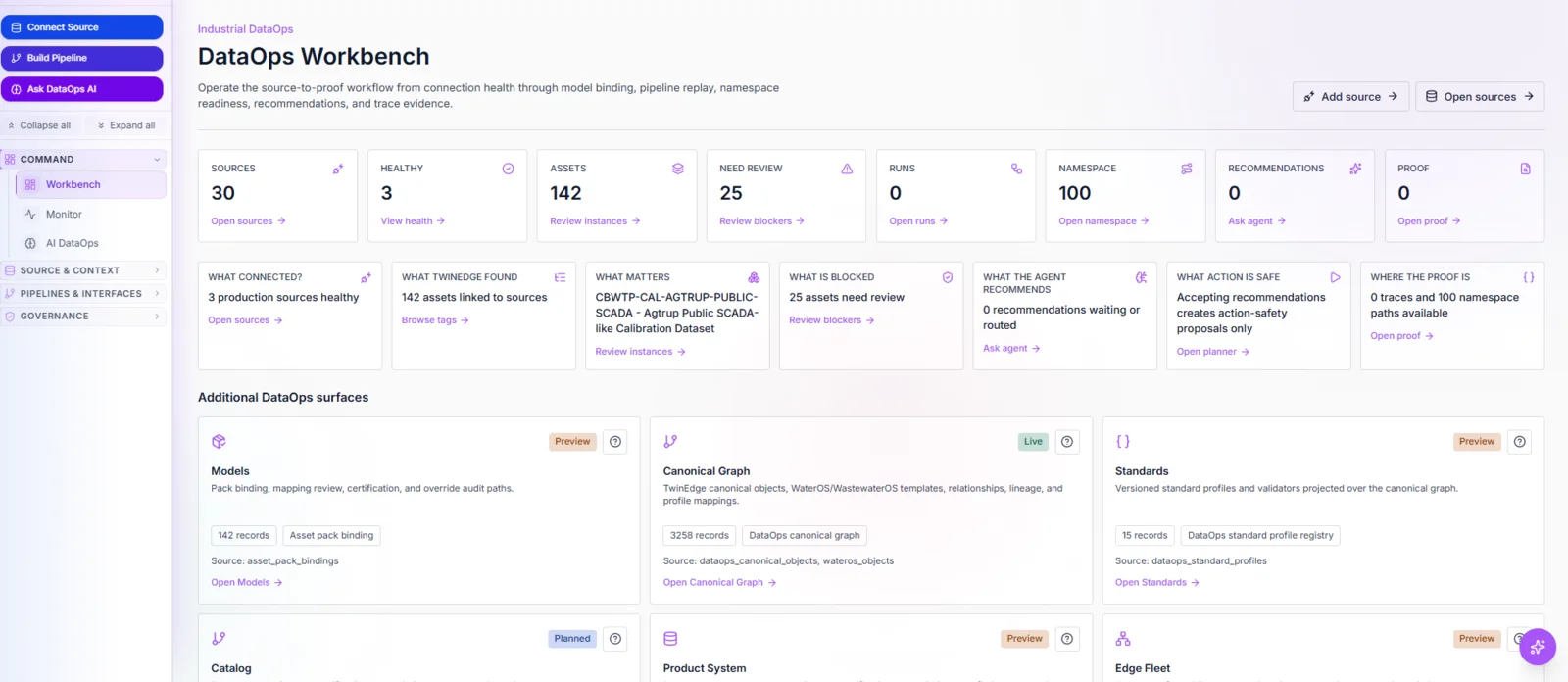
TwinEdge DataOps Workbench

Industrial DataOps Workbench for UNS, MCP, and AI-ready operations.

TwinEdge connects OPC UA, MQTT/Sparkplug, historians, databases, files, REST APIs, cloud storage, GIS, and enterprise systems; models them into governed asset, namespace, and canonical graph context; then publishes trusted REST and MCP data products for BI, agents, digital twins, and operational workflows.

DataOps readiness pipelineSource data, industry packs, and standard profiles become governed AI-ready products.QualityLineageReplayRAW INDUSTRIAL DATAWORKBENCH CONTEXT BUILDAI-READY PRODUCTSOT sourcesOPC UA, Modbus, MQTTFiles and tablesCSV, JSON, ParquetGeospatialGeoJSON, GIS, mapscanonical namespace + operational graphBrowsetags, topics, tablesBindassets and instancesValidatequality and profilesGraphcanonical contextAPI/MCPAI-readable productsCataloglineage and reuseMonitorquality and replayIndustry pack and standard-profile supportProject native context into the formats your plant, utility, integrator, and AI clients already understand.WaterOSWastewaterOSi3XSparkplug BISA-95AASOGC WaterMLSensorThingsEPA WQXSWANSOSA/SSNHaystackBUSINESS OUTCOMES BEFORE AI RECOMMENDS ACTIONReadiness scoreknow what AI can trustReusable model layerone mapping, many productsGoverned activationapproval, diff, replay

Connections

Conditioning

Models

Pipelines

UNS

REST/MCP

TwinEdge makes industrial data useful, physics-aware, AI-governed, and operationally actionable.

Workflow

From industrial source to governed data product

Connect industrial sources, contextualize them into reusable operational models, govern the namespace, and publish trusted data products for teams and AI systems.

Connect and inspect source systems

Register source types, browse tags and topics, inspect payloads and schemas, validate quality, and see what is ready for analytics or publication.

Contextualize and govern the namespace

Map raw data to assets, instances, units, standards, UNS structures, graph relationships, and digital twin inputs so every consumer gets the same meaning.

Publish and operationalize

Expose governed context through cataloged REST APIs, scoped MCP tools, monitoring, approval gates, replayable changes, and downstream operational workflows.

Capabilities

Industrial DataOps capabilities

The workbench covers the core Industrial DataOps buyer checklist, then extends it into TwinEdge twins, agents, EAM, Field, and evidence-backed execution.

Connections and conditioning

Source catalog, tag browser, topic inspection, schema review, unit normalization, quality checks, freshness, transformations, and readiness scoring.

Models, pipelines, and UNS

Reusable asset models, instances, transformations, pipelines, namespace design, canonical graph bindings, profile projections, and operational standards.

REST and MCP publishing

AI-readable data products with catalog entries, schemas, tenant scope, monitor, lineage, approval review, audit trails, and default read-only MCP access.

Where TwinEdge goes further

Industrial DataOps that does not stop at contextualized data.

Standalone DataOps hubs can make plant data cleaner and easier to consume. TwinEdge uses that same governed context as the foundation for physics twins, agents, work execution, field evidence, and operational learning loops.

Physics-aware operational context

Tags, topics, records, and files can bind to asset models, operating envelopes, process twins, failure modes, and physics model inputs.

Governed AI and MCP by default

Published REST and MCP products carry schemas, scope, catalog metadata, approval state, audit history, and replayable source context.

Action loop beyond the data layer

Validated context can flow into Agentic Analytics, AssetOps EAM, Field, GIS-aware response, BI, reports, and evidence-backed work closeout.

Sources, UNS, and profiles

Supported source families, namespace patterns, and standard-profile projections

TwinEdge uses a native canonical graph, supports MQTT/Sparkplug and Unified Namespace patterns, then projects into standard profiles where relevant so teams can keep local operating context and still support exchange patterns.

CSVJSONParquetOPC UAMQTTSparkplug BModbus TCP/RTUSQLRESTWebhooksEvent HubsS3Azure BlobGoogle Cloud StorageGeoJSONShapefile ZIPKMLGeoPackageGPXWaterOSWastewaterOSOGC WaterMLSensorThingsSOSA/SSNEPA WQXSWANi3XISA-95AASHaystack previewBrick plannedASHRAE 223 planned

Engineering controls

Engineering controls for industrial AI.

TwinEdge can show real telemetry, local inference, protocol flows, and agent traces without claiming uncontrolled autonomy or SCADA replacement.

Read-only first

Physical writeback is disabled by default and recommendations pass through approval gates.

Replayable evidence

Plans, diffs, source context, and approval history remain available for review.

Deployment choice

Cloud-connected, local, and offline paths support evaluation without forcing one architecture.

Source system respect

TwinEdge works above SCADA, historians, CMMS, GIS, LIMS, ERP, and data lakes rather than pretending to replace them all.

Outcomes

Why teams choose TwinEdge DataOps

The value is not only contextualized data. TwinEdge carries that context into twins, recommendations, work, field evidence, BI, APIs, and AI systems.

Data teams

Replace ad hoc tag spreadsheets and brittle point-to-point integrations with governed source-to-context workflows.

Plant engineers

Make signal meaning, units, asset identity, and namespace structure explicit so analytics match the real operation.

AI teams

Give agents clean, scoped, replayable operational context instead of raw telemetry dumps or generic API wrappers.

Operations teams

Move validated context into recommendations, work drafts, field tasks, approvals, and evidence-backed closeout.

Connected platform

Extend the same context across the operating layer

DataOps Workbench creates the physics-aware, AI-ready context.

Agentic Analytics uses that context to explain, draft, and validate recommendations.

TwinEdge OS supports cloud-connected, offline, and protocol-rich edge deployments.

AssetOps EAM and Field close the loop from recommendation to evidence-backed work.

Water, wastewater, chemical, water loss, lab, and facility products package industry workflows.

REST and MCP data products make context available to enterprise applications and AI systems.

Evaluate TwinEdge

Plan your first TwinEdge workflow.

Review the operating model with our team, or download TwinEdge to evaluate the platform in your own environment.