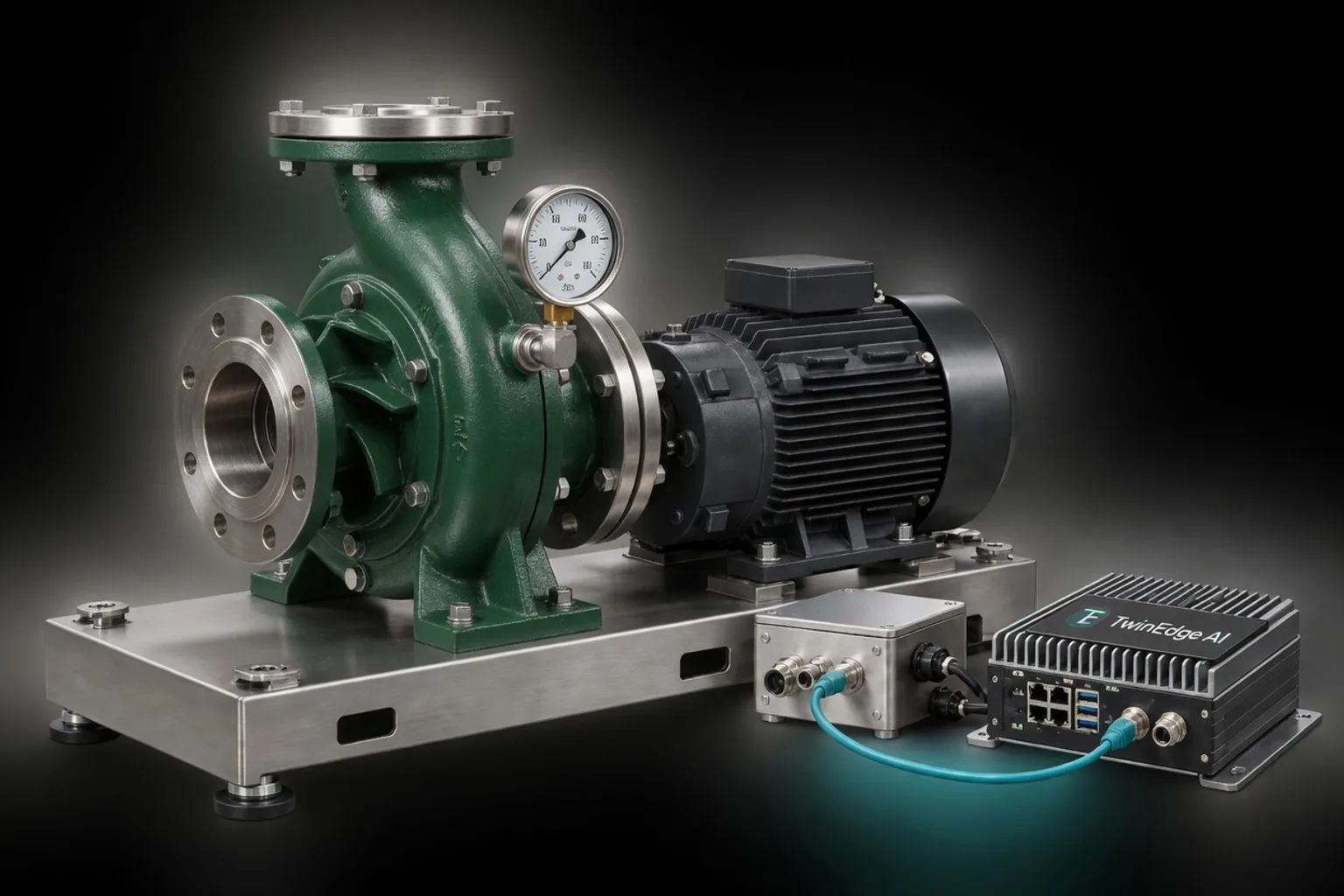
A working copy of the machine. Try the change here first.
TwinEdge builds a twin of any physical asset — a pump, blower, chiller, and the rest — from how it actually works. You can see extra power or wear, try a change in the model, and plan the repair without touching the real machine.
If the pump uses more power for the same flow, the twin shows it.
Plan the stop
Wear shows up in the model before the pump trips the process.
Repair or replace
Energy, service cost, and history sit on the same pump record.
§ 01
What you get from the twin.
Four things your team can use on Monday, on any physical asset, without a new control system.
01See wasted energy
If an asset uses more power for the same work, the twin shows it in plain numbers.
02Try the change first
Change a setpoint or duty in the copy. Nothing on the real machine moves.
03Know what else stops
The twin is wired the way the plant is wired, so a failure on one unit shows what goes down next.
04Plan repair versus replace
Energy, service cost, and history sit on the same asset, ready for the next budget.
§ 02
The asset, then the whole plant.
A twin of one pump is useful. A twin of the cooling loop is why you can trust it. Heat from IT has to leave through CRAH, pumps, and the chiller. Play a short run: the pump wears, physics shows extra power, TwinEdge drafts the job, a person approves, and the hall is back on the model.
Asset + plant, in one runILLUSTRATED MODEL
Heat in
IT hallsInlet 22 °C
Air
CRAH / CRACBlows cold air down the aisle
Water
CHW pump22 kW measured · 22 kW expected
Plant
ChillerOn duty
Physics. Heat from IT ≈ heat the cooling plant must remove.
01 Healthy
The hall is cool. The plant matches the twin.
IT load makes heat. Chillers, pumps, and CRAH remove that heat. Measured pump power matches what physics expects for this flow.
ReadExplainRecommendApproveVerify
Not a live plant. A short model of one cooling loop and one pump.
§ 03
The numbers come from physics, not a black box.
Ask a reliability engineer to take a pump out of service on the word of a neural network and watch what happens. They will want to know why, in terms they can check against the curve on the wall. A pump obeys equations that have not changed in a hundred years, so the sensible thing is to use them — and to keep the working visible.
A model that is right 95% of the time and cannot explain itself will be ignored. A calculation that shows its working gets acted on, because when it is wrong an engineer can see why in about thirty seconds.
Being checkable beats being clever. Efficiency, the operating point on the manufacturer curve, how fast the machine is getting worse, and readings that cannot be true all run continuously on the box at the site. TwinEdge DRIVE tests a variable-speed move against the same model before anything reaches the drive.
“Not a better answer. An answer somebody is willing to be wrong about in public.”
What physics gives you that a model cannot
§ 04
Why one machine is not enough.
A model of a single pump tells you about that pump. It cannot tell you that the reason the pump is struggling is a partly closed valve two stages upstream, because it has never heard of the valve.
Most of the expensive problems in a plant are like this: the symptom appears on one machine and the cause is somewhere else. Only a model that knows what is connected to what can follow that back.
It is also how you answer a question worth asking: if this fails, what stops?
“The machine showing the symptom is very rarely the machine with the problem.”
Why the connections matter
Model your connected operation.
Connect equipment models, operating data, and process relationships through the TwinEdge AI package. Compare subscriptions on the pricing page.