TwinEdge Capital Planning

AI-created capital plans from live asset lifecycle intelligence.

TwinEdge Capital Planning uses asset registry, GIS, telemetry, work history, condition models, lifecycle costs, risk, and funding constraints to draft replacement plans, compare scenarios, optimize capex/opex, and route approved programs into projects, SAMP evidence, reports, and audit trails.

AI capital plan from asset lifecycleTwinEdge turns live asset context into ranked renewal candidates, modeled scenarios, and funded programs.AI draftModelerOptimizerASSET LIFECYCLE CONTEXTCAPITAL PLANNING ENGINEREVIEW-READY OUTPUTRegistryassets + GISOperatetelemetry + PMsConditionRUL / EOLRiskcost + criticalityautomatic recommendationsDeteriorateasset modelsLifecyclecapex / opexWhat-ifscenariosMILPoptimizeAdvisorAI rankVDMvalue choiceDraft planrenewal yearsFundinggrant / bondProjectsBOM + deliverySAMPreports + auditRecommendation packageCapital Advisor drafts the replacement plan, explains source signals, and compares the baseline with optimized funding paths.planner approval requiredEND-TO-END ASSET LIFE CYCLEDiscoverasset graphOperatework historyPredictcondition riskInvestfunded scenarioDeliverproject proofAccepted scenarios flow into projects, SAMP, executive reports, and audit history.

Asset insights

AI recommendations

Scenario modeler

MILP optimize

Funding mix

SAMP evidence

TwinEdge turns complete asset insight into recommended, modeled, and review-ready capital programs.

Workflow

From asset lifecycle to automatic capital plan

Connect industrial sources, build trusted context, govern recommendations, and turn approved decisions into operational work.

Connect the full asset record

Use hierarchy, GIS, telemetry, work history, condition, criticality, O&M/EOM context, cost, and compliance facts already managed in TwinEdge.

Generate and optimize recommendations

Capital Advisor ranks renewal candidates, drafts replacement plans, tests what-if scenarios, and runs optimization against budget and risk constraints.

Approve a funded program

Move the accepted scenario into funding sources, projects, milestones, construction tracking, BOM context, SAMP reports, and audit evidence.

Capabilities

What capital teams can manage

AI-generated replacement plans

Configured assets, condition, RUL/EOL, deterioration models, lifecycle costs, risk matrix, and planning signals feed recommended renewal years.

Scenario and algorithmic analysis

Scenario comparison, modeler, what-if engine, MILP optimization, capex/opex projection, funding sources, and value-based decisions.

Program execution and governance

Capital projects, milestones, construction tracker, BOM generator, compliance calendars, SAMP approvals, executive reports, and audit trails.

AI planning engine

Recommendations start from the asset record, not a blank spreadsheet.

Because TwinEdge already manages the asset lifecycle, the capital planning module can create a first-pass capital program from real condition, risk, operating, cost, and compliance context.

Planning signals

Condition, RUL/EOL, work history, PM exposure, criticality, cost, service impact, and compliance deadlines become scored renewal candidates.

Algorithms and scenarios

Deterioration curves, lifecycle costs, what-if runs, MILP optimization, and value-based decision models compare options under real constraints.

Automatic outputs

TwinEdge drafts replacement plans, funding mixes, project candidates, BOM context, executive reports, and SAMP evidence for review.

Module coverage

Capital planning features already represented in the module

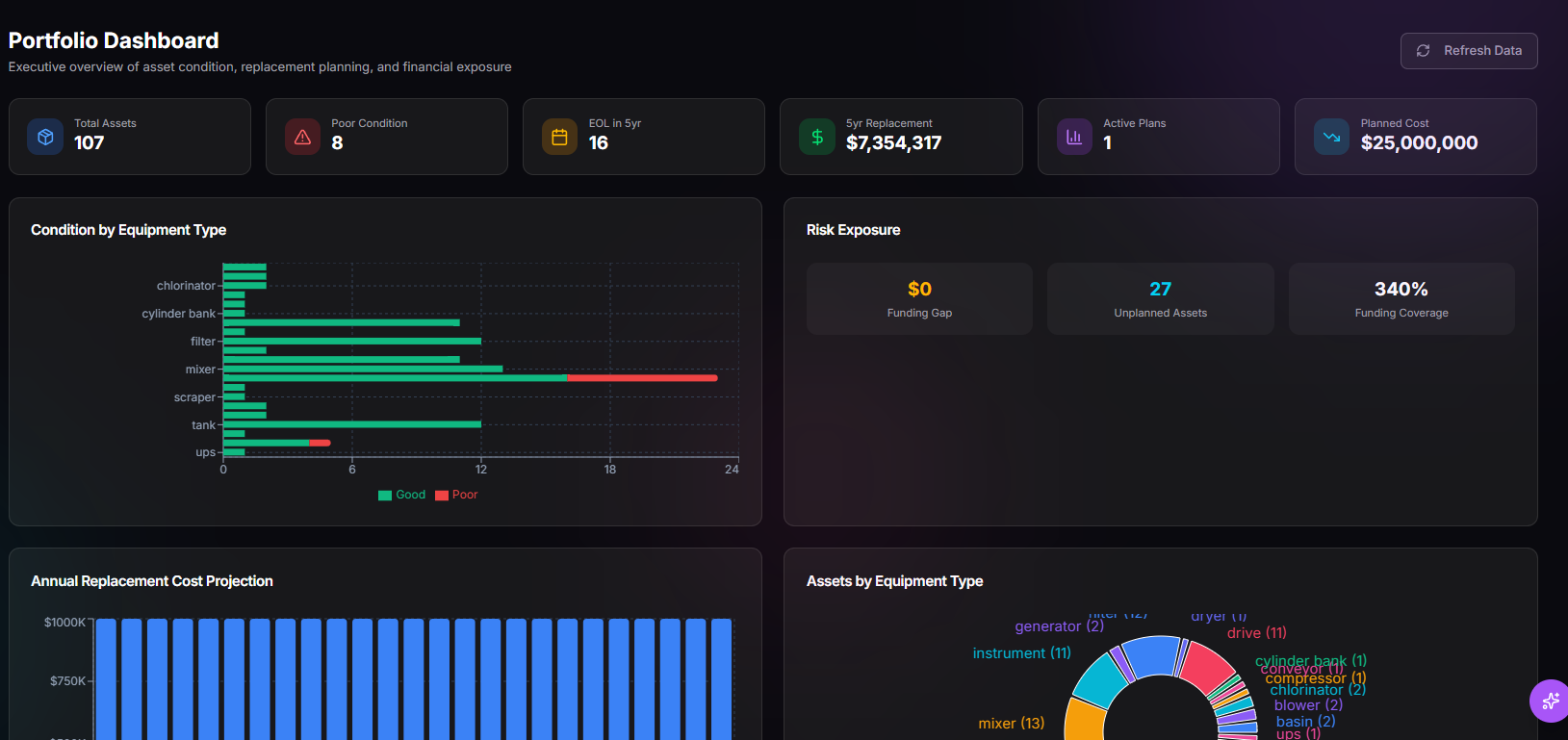
The marketing page now reflects the actual planning surfaces available across portfolio planning, analysis, governance, and reporting.

Configured assetsReplacement plansPortfolio dashboardScenario comparisonScenario modelerCapex / opex projectionsFunding sourcesProjectsCapital planning mapSite selectionConstruction trackerBOM generatorAdvisorRisk matrixDeterioration libraryLifecycle costsWhat-if engineMILP optimizeValue-based decisionsSAMP workflowsExecutive reportsCompliance calendarAudit trail

Engineering controls

Governed controls for capital planning decisions.

TwinEdge can automatically draft and recommend capital programs, while accepted plans remain reviewable, explainable, and governed before they become funded work.

Advisory by default

AI recommendations explain source signals and planning assumptions before a planner accepts or overrides the recommendation.

Traceable assumptions

Deterioration model, lifecycle cost, risk score, funding constraint, and scenario inputs remain visible for review.

Scenario acceptance

Optimized scenarios can be compared against baseline and budget-constrained alternatives before approval.

Audit and SAMP evidence

Reports, approvals, diffs, history, and SAMP workflow artifacts preserve the capital decision record.

Outcomes

Operational value

Teams get the context, controls, and execution path needed to move from noisy industrial data to approved operational action.

Asset managers

Move from manually assembled renewal spreadsheets to AI-drafted plans grounded in condition, risk, lifecycle cost, and service context.

Finance and CIP teams

Compare funding paths, budget curves, bond reports, grant drafts, and multi-year capex/opex scenarios before committing.

Leadership

Show why each investment matters with traceable source signals, optimized alternatives, compliance exposure, and SAMP-ready evidence.

Connected platform

Capital planning uses the same asset truth as the operating layer

The capital plan is not separate from operations. It is generated from the same TwinEdge asset lifecycle context used by DataOps, AssetOps, Field, GIS, digital twins, recommendations, and governed reports.

AssetOps EAM supplies asset hierarchy, condition, work history, PMs, reliability context, parts, O&M/EOM evidence, and lifecycle status.

DataOps and digital twins connect telemetry, historian signals, GIS, criticality, costs, and operating context to each capital asset.

Capital Advisor explains recommended renewal candidates with source signals, confidence, and planning assumptions.

Scenario modeler, what-if analysis, MILP optimization, and value-based decision models compare budget, risk, deferral, and service impacts.

Funding sources, capital projects, construction tracker, BOM generator, compliance calendars, and SAMP workflows turn accepted scenarios into execution.

Executive reports and audit trails preserve the decision path from asset evidence to approved capital program.

Evaluate TwinEdge

Plan your first TwinEdge workflow.

Review the operating model with our team, or download TwinEdge to evaluate the platform in your own environment.