Water twin starter

Start with a Pump Station Twin and expand into water and wastewater operations.

The Water Twin Starter focuses on one high-value utility workflow: pump station telemetry, risk, energy, maintenance, field response, and evidence-backed recommendations.

How the TwinEdge utility digital twin worksSCADA, EAM, GIS, lab data, physics, and simulation resolve into one water and wastewater system map.DATA SOURCESDIGITAL TWIN ENGINEOPERATING OUTPUTSCADA sourcelive tags, alarmshistorian trendsEAM assetsasset hierarchywork + conditionGIS + networkpipes, zones, sitessystem topologyLab + qualitysamples, limitspermit contextTwinEdge water and wastewater digital twinSemantic graphassets + processsource bindingsPhysicspump curvesmass balanceSimulationwhat-if runsscenario replayAnalyzedeviation + riskrecommendationsTwinEdge system mapplants, assets, network, process state, and evidenceWTPStorageNetworkLiftWWTPSystem mapwater + wastewateroperating stateDecision packetmodel evidenceapproved actionEAM + Fieldwork order pathcloseout proofGoverned digital twin railSource lineageModel versionScenario resultApprovalReplay

Pump telemetry

Risk

Energy

Maintenance

Field response

Evidence

A concrete entry point for utility operations.

Enterprise utility view

See every critical water and wastewater decision through one trusted operating model

Plant leaders, engineering, operations, and maintenance teams get the same live context for treatment performance, wastewater process state, chemical dosing, scenario planning, and quality risk before priorities turn into work.

TwinEdge water treatment plant digital twin screenshot showing plant process units, telemetry, operating status, and context panels
Water treatment

Water treatment plant center twin

A treatment-center twin brings plant assets, telemetry, operating status, and process context into one utility view.

TwinEdge wastewater treatment plant digital twin screenshot showing process stages, alarms, compliance context, and operating priorities
Wastewater

Wastewater plant center twin

Wastewater process context connects headworks, treatment stages, alarms, compliance evidence, and operating priorities.

TwinEdge chemical dosing pump digital twin screenshot showing pump status, dose targets, quality readings, inventory, and response context
Chemical dosing

Chemical dosing pump twin

Chemical dosing context ties pump status, dose targets, quality readings, inventory, and operator response into the utility twin.

TwinEdge digital twin plant scenarios screenshot showing simulated operating conditions and modeled response paths
Simulation

Plant scenario simulation

Scenario runs compare operating assumptions, plant constraints, and modeled responses before teams commit to an action.

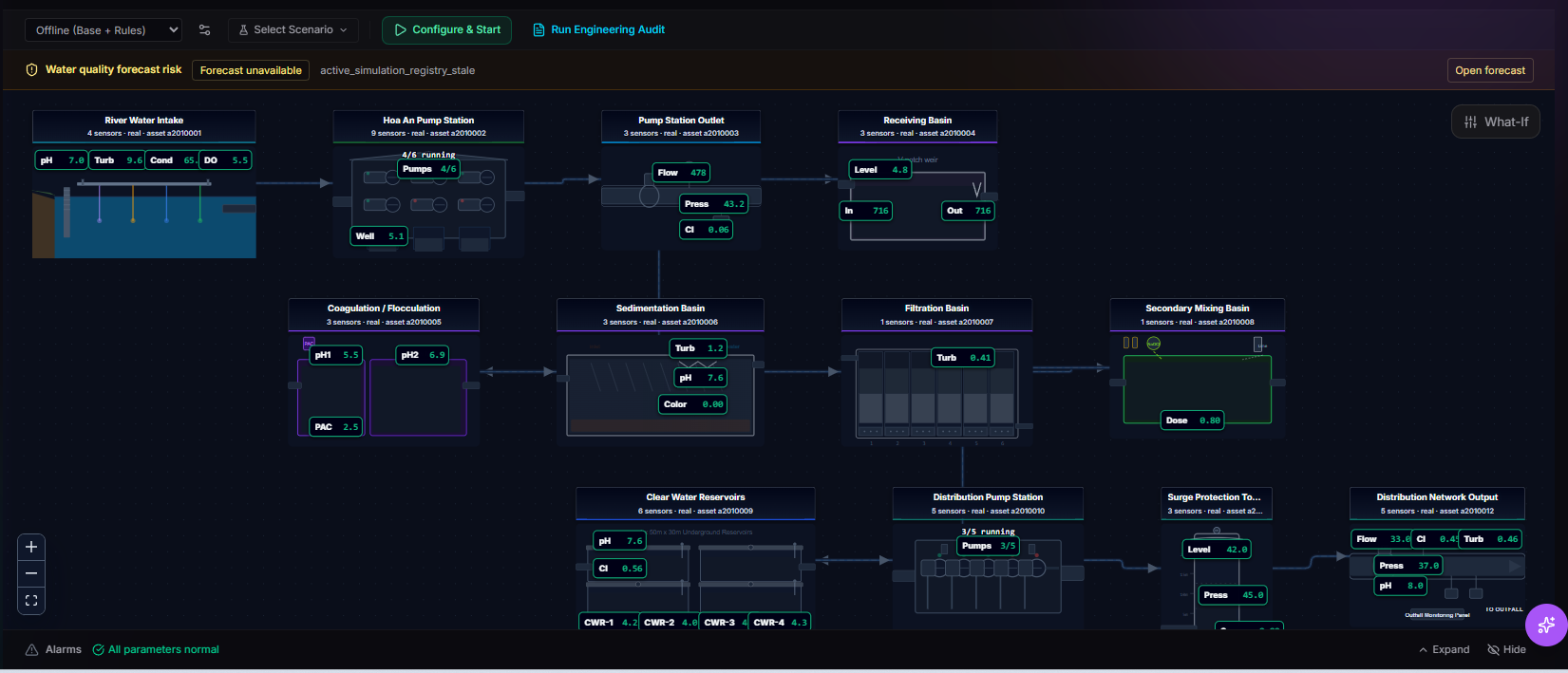
TwinEdge digital twin water quality forecast screenshot showing modeled quality risk and process forecast context
Forecast

Water quality forecast twin

Forecast views connect quality readings, process state, and model output so operators can see risk before it becomes an excursion.

Workflow

Utility physics from asset to process to evidence

Connect industrial sources, build trusted context, govern recommendations, and turn approved decisions into operational work.

Model assets and process flow

Represent pump stations, lift stations, plants, network zones, dosing points, and field assets with physics-aware operating context.

Attach telemetry and operating envelopes

Connect signals to assets, performance curves, quality readings, alarms, process state, and maintenance context.

Route recommendations to action

Create approved work, field response, compliance notes, and executive visibility from one physics-grounded context layer.

Capabilities

Utility twin modules

Pump Station Twin

Telemetry, pump curves, operating envelope deviation, energy, maintenance risk, alarms, work, and field evidence.

Treatment and network context

Plant process physics, lift stations, collection/distribution context, quality, and water loss signals.

Compliance and evidence

Lab, field, quality, maintenance, and operational records tied to the asset and event timeline.

Twin context

Water and wastewater canonical templates and profile projections

Water and wastewater twins use utility operating vocabulary with standard-profile adapters over canonical context.

Water treatment processWater storagePressure zonesDistribution networkWater quality observationChemical dosingWater compliance pointCollection systemLift stationHeadworksBiological treatmentClarificationDisinfectionSolids handlingCSO/SSO eventEffluent qualityWastewater compliance pointOGC WaterMLOGC HY_FeaturesSensorThingsSOSA/SSNEPA WQXSWANi3XSparkplug B

Engineering controls

Engineering controls for industrial AI.

TwinEdge can show real telemetry, local inference, protocol flows, and agent traces without claiming uncontrolled autonomy or SCADA replacement.

Read-only first

Physical writeback is disabled by default and recommendations pass through approval gates.

Replayable evidence

Plans, diffs, source context, and approval history remain available for review.

Deployment choice

Cloud-connected, local, and offline paths support evaluation without forcing one architecture.

Source system respect

TwinEdge works above SCADA, historians, CMMS, GIS, LIMS, ERP, and data lakes rather than pretending to replace them all.

Outcomes

Operational outcomes

Teams get the context, controls, and execution path needed to move from noisy industrial data to approved operational action.

Utility operations

Move from alarms and spreadsheets to connected asset context and prioritization.

Maintenance leaders

Turn risk signals into work with parts, safety, and completion evidence.

Executives

Start with a concrete utility workflow and expand toward Water OS or Wastewater OS.

Connected platform

Extend the same context across the operating layer

DataOps Workbench creates the physics-aware, AI-ready context.

Agentic Analytics uses that context to explain, draft, and validate recommendations.

TwinEdge OS supports cloud-connected, offline, and protocol-rich edge deployments.

AssetOps EAM and TwinEdge Field close the loop from recommendation to work, guided mobile diagnostics, human-reviewed evidence, and closeout.

Water OS, Wastewater OS, Chemical OS, Water Loss OS, Water Quality, Capital Planning, ESG, and Facility OS package industry workflows.

REST and MCP data products make context available to enterprise applications and AI systems.

Frequently asked questions

Questions about Water twin starter

Clear answers for buyers, operators, engineers, and evaluation teams.

What is a water and wastewater digital twin?

It is a live operational model that connects asset identity, telemetry, process state, engineering relationships, operating envelopes, maintenance, and field evidence for water or wastewater systems.

Which utility assets can TwinEdge model?

TwinEdge supports focused twins for pump stations, lift stations, treatment processes, distribution and collection context, chemical dosing, water quality, and related field assets.

How is a physics-based twin different from a dashboard?

A dashboard visualizes measurements. A physics-based twin evaluates those measurements against equipment curves, equations, process relationships, constraints, and operating envelopes to explain condition and test scenarios.

Can a utility start with one station or process?

Yes. The recommended adoption path is one source, one asset class, and one measurable workflow, such as a pump station or lift station, before expanding into a wider utility operating layer.

How do twin findings become maintenance work?

Twin findings can be reviewed as evidence-backed recommendations, routed through human approval, and handed to AssetOps or an integrated maintenance system with relevant asset, parts, safety, and field context.

Evaluate TwinEdge

Plan your first TwinEdge workflow.

Review the operating model with our team, or download TwinEdge to evaluate the platform in your own environment.