TwinEdge Water Quality and Regulatory

A governed water-quality operating record from sampling plan to regulatory signoff.

TwinEdge Water Quality and Regulatory brings lab, field, asset, treatment, permit, and reporting evidence into one workflow, so leaders can see what is due, what changed, what is ready for review, and what needs action before it reaches the report.

Water quality and regulatory evidence mapLab, LIMS, sampling, QC, limits, deadlines, and signoff stay connected to Water OS and Wastewater OS.LabWater OSReportsSOURCE CONTEXTLAB + REGULATORY SPINEACTION SURFACESConnectoperating and lab systemsWater OSWastewater OSLab APIField routesInstrumentsOnline sensorsGIS/CMMSRule packssource-to-signoffSample lifecycle, source depth, report traceability, governed AIPlansamples + routesCustodyreceipt + transferResultsentry + importQA/QClimits + reviewCompareMCL, PFAS, LCRSignoffreports + proofQuality boardlifecycles + depthExceedancesactions + noticesDeadlinesDMR, CCR, TCRProgram packsPFAS, LCR, TCRReport tracefacts + rulesFITS INSIDE THE WATER AND WASTEWATER OS MAPWater OSsource-to-tapSourceTreatmentChemicalsDistributionWastewater OSpermit-to-reportCollectionTreatmentEffluentNPDESWQ/LabevidencesignoffCUSTOMER OUTCOMESFewer missed samplesroutes and calendarFaster reviewQC and exceptionsDefensible reportsfacts, rules, evidenceBetter operationsquality context in OS

Sample lifecycle

Source depth

Route readiness

QA/QC review

Exception response

Regulatory signoff

Every sample, result, exception, deadline, and report stays tied to source evidence.

Operating evidence in motion

A quality record executives can trust before it reaches the report

The screens connect Water OS state, lab queues, routes, custody, results, QA/QC, deadlines, PFAS and Lead and Copper Rule programs, AI insight, and anomaly history into one trail from collection to signoff.

TwinEdge Water Quality and Regulatory operating board showing sample lifecycles, exceedance workflows, regulatory calendar, reports, and source depth
Water OS state

Enterprise quality operating board

Leaders see sample status, exceptions, deadlines, program coverage, and report evidence from one Water OS operating record.

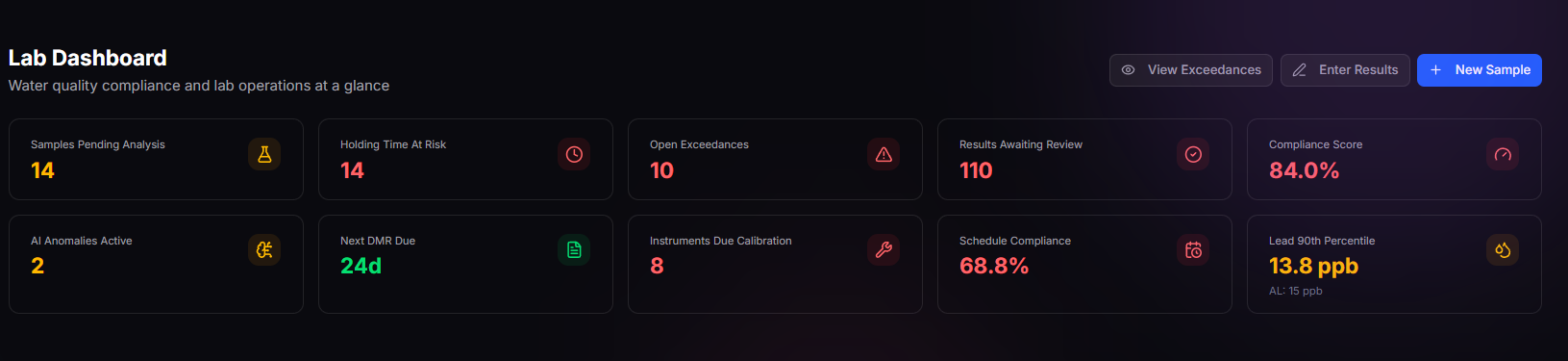
TwinEdge Lab dashboard showing samples pending analysis, holding-time risk, open exceedances, results awaiting review, compliance score, schedule compliance, and LCR status
Lab command

Lab dashboard

Pending analysis, holding-time exposure, review queues, instrument state, DMR timing, and LCR status are visible before work starts moving.

TwinEdge sampling routes screen showing route cards, selected distribution route, locations, timing, and optimization action
Collection planning

Sampling routes that protect the schedule

LCR, distribution, emergency resampling, outfall, and process-profile routes carry locations, timing, and collection priorities into the field.

TwinEdge samples screen showing sample lifecycle rows with locations, matrices, collection times, status, result counts, and priority
Custody

Sample lifecycle with custody intact

Every sample carries location, matrix, status, result count, priority, collection time, and custody context from plan through receipt and review.

TwinEdge result entry screen showing sample result grid, filters, instrument import, and save all action
Results

Result entry without losing context

Instrument imports and grid entry preserve method, unit, qualifier, detection limit, analyst, and sample context before records move to review.

TwinEdge QA/QC dashboard showing a Levey-Jennings chart, control state, parameter and instrument filters, and control limits
QA/QC

QA/QC review before decisions move

Control charts, limits, instrument filters, and recalculation actions give reviewers the evidence they need before results drive compliance action.

TwinEdge regulatory deadline tracker showing obligations, reporting periods, due dates, accepted status, report type, and confirmation identifiers
Deadlines

Regulatory calendar with evidence attached

LCR, RTCR, DMR, CCR, PFAS, sanitary survey, consent decree, and violation obligations carry due dates, status, type, and confirmation evidence.

TwinEdge PFAS monitoring screen showing compliant PFAS cards, result table, hazard index, and treatment status by location
PFAS

PFAS monitoring in the operating record

PFOA, PFOS, PFHxS, PFNA, HFPO-DA, hazard index, treatment status, thresholds, and treatment assets stay connected to the program record.

TwinEdge Lead and Copper Rule dashboard showing monitoring period, samples collected, lead and copper 90th percentile status, action level alert, and service line inventory
LCR

Lead and Copper Rule readiness

Monitoring periods, samples collected, 90th-percentile status, action-level alerts, and service-line inventory context stay visible together.

TwinEdge AI insights screen showing water quality anomaly cards with severity, predicted values, confidence, recommended action, and evidence
AI review

AI insights with source evidence

Anomaly cards surface lead, BOD5, and total coliform signals with severity, status, predictions, confidence, recommended action, and supporting evidence.

TwinEdge anomaly detection history screen showing filters, severity, status, anomaly descriptions, timestamps, and confidence scores
AI history

Anomaly history for review and replay

Status, severity, agent, parameter, timestamp, confidence, and investigation context remain searchable for compliance and operations review.

Workflow

From Water OS context to regulatory signoff

A result is never treated as a disconnected row. The record keeps the operating context, collection location, custody movement, instrument evidence, QA/QC decision, affected rule, response action, and final signoff together.

Bring in operating context

Water OS and Wastewater OS pass source, treatment, distribution, collection, permit, asset, field, and customer context into the quality workflow before samples are planned.

Plan, route, collect, and receive

Teams manage sampling plans, schedules, LCR routes, emergency resampling routes, sample records, receipt, custody events, field measurements, photos, and collection metadata.

Enter, import, and review results

Instrument import and spreadsheet-style entry preserve method, unit, qualifier, detection limit, analyst, raw-result evidence, QA/QC flags, and control-chart review state.

Compare, respond, and sign off

Reviewed results flow into MCL/PFAS/LCR/TCR/DMR/CCR checks, exceedance workflows, deadline confirmations, corrective action, public notice, report traceability, and signoff readiness.

Capabilities

What enterprise water-quality teams can see and control

Quality leaders need confidence before results become obligations. TwinEdge connects operational context, lab execution, program deadlines, report evidence, and governed AI review into one record.

Water OS quality state

Sample lifecycles, exceptions, calendar obligations, program coverage, source depth, report facts, rule pins, and evidence references stay visible together.

Sampling plans, schedules, and routes

Sampling locations, batches, schedules, LCR routes, emergency residual routes, outfall routes, process routes, and GPS-ready collection context move into field execution.

Custody, instruments, and result entry

Receipt, transfer, custody snapshots, instrument import, grid entry, method, unit, qualifier, detection limit, and analyst context remain attached to the result.

QA/QC review and control statistics

Control charts, holding-time checks, duplicate precision, spike recovery, unit consistency, review status, and release evidence sit in the same approval path.

Compliance programs and deadlines

PFAS, Lead and Copper Rule, TCR, DMR, CCR, NPDES, MCL limits, accepted confirmations, public notice workflows, and report package state stay connected.

AI insights and governed response

Anomalies, forecasted compliance exposure, recommended actions, confidence, source evidence, acknowledgement, false-positive handling, and approved action paths remain reviewable.

Operating picture

Quality and regulatory work reads as one controlled chain.

Lab dashboards, route planning, custody, result entry, QA/QC, deadline tracking, PFAS and LCR program views, AI insights, and Water OS quality state all point back to the same evidence trail.

Water OS quality and regulatory board

The Water OS view shows sample lifecycles, exceedance workflows, calendar workflows, program coverage, source depth, and report traceability from one operating state.

Lab execution surfaces

Dashboards, sampling routes, sample lifecycle rows, custody events, result entry, instrument import, and QA/QC charts support the day-to-day work analysts and field teams perform.

Regulatory program surfaces

PFAS monitoring, Lead and Copper Rule, deadline confirmations, DMR/CCR/TCR workflows, exceedance queues, and signoff readiness keep compliance action tied to reviewed evidence.

Industry workflows

One evidence layer across regulated water operations.

The same sample, result, method, custody, and report model supports water treatment, distribution, wastewater permits, environmental monitoring, and industrial quality workflows.

Water treatment and distribution

Connect samples to residual, pH, turbidity, corrosion-control, disinfection, service-line, customer impact, and public reporting decisions.

Wastewater and environmental monitoring

Tie influent, process, effluent, receiving-water, industrial pretreatment, biosolids, NPDES, and environmental monitoring results to permit evidence.

Industrial QA and operations analytics

Use sample lifecycle, instrument evidence, methods, QC, batch context, asset context, and reporting workflows as the quality evidence layer for operational analytics.

Agent-assisted operations

AI supports review, prediction, and planning without hiding the evidence.

Quality and regulatory agents surface the next issue to inspect while explanations, confidence, review queues, approvals, and replayable evidence remain visible.

Auto QC reviewer

Flags common quality issues so analysts focus on exceptions, release decisions, and defensible notes instead of scanning every row manually.

Predictive compliance

Uses historical results, limits, and operational context to surface forecasted exceedance risk before it becomes a reportable surprise.

Sampling optimizer and regulatory assistant

Helps teams plan routes, prioritize schedules, explain obligations, and answer compliance questions using governed lab and regulatory context.

Connected surfaces

The lab record becomes regulatory evidence

Sampling, custody, results, QA/QC, exceptions, reports, work, and field evidence stay connected instead of scattering across spreadsheets, exports, folders, and email.

Sampling locationsSample batchesMethodsInstrumentsResultsQC statisticsHolding timesChain of custodySchedulesRoutesExceedancesRegulatory limitsDMRCCRLCRTCRService linesPublic notificationInstrument importsAudit logAI predictionsWork ordersDosing and residualWater OSWastewater OSChemical OSAssetOps EAMFieldAPI and MCP

Engineering controls

Controls for defensible laboratory evidence.

TwinEdge Lab is positioned as a governed lab operating layer: source evidence, custody, review gates, regulatory context, and approvals stay visible before results drive reports or operational action.

Custody by design

Sample identity, collection context, receipt, transfer, preservation, temperature, and chain-of-custody events remain connected to the result.

Review before release

Holding-time checks, detection limits, duplicate precision, spike recovery, unit consistency, flags, and analyst approvals support controlled release.

Source system respect

TwinEdge Lab works above instruments, SCADA, GIS, CMMS, ERP, reporting systems, and existing LIMS investments instead of pretending to replace every system on day one.

Audit and replay

Reports, exceedances, recommendations, and operational decisions can point back to the reviewed result, source evidence, and approval trail.

Outcomes

What leaders can walk into a review with

The same record gives lab, compliance, operations, and executive teams a shared answer for readiness, exceptions, public reporting, and corrective action.

Lab managers

Coordinate sample plans, custody, instruments, QC queues, analyst review, and reporting status without chasing paper forms, shared drives, and manual spreadsheets.

Water quality and compliance teams

Move from result-by-result firefighting to traceable exceedance review, report preparation, public notification, service-line workflows, and audit-ready evidence packages.

Operators and maintenance teams

See the lab result in operating context: treatment stage, dosing, residual, asset state, work order, field action, and whether the decision has been reviewed.

Executives and customer-facing teams

Explain quality risk, regulatory readiness, customer impact, and improvement work with a single evidence story rather than disconnected departmental updates.

Connected platform

Connected to the TwinEdge water industry spine

Water Quality and Regulatory connects lab evidence to Water OS, Wastewater OS, Chemical OS, AssetOps EAM, Field, DataOps, API/MCP, and regulatory workflows.

Water OS and Wastewater OS pass plant, distribution, collection, treatment, permit, customer, and operating context into Lab.

Sampling locations, sample batches, analytical methods, instruments, regulatory limits, custody events, and schedules become one traceable record.

Instrument files, field measurements, photos, temperature checks, GPS, analyst notes, and review decisions stay attached to the sample lifecycle.

DMR, CCR, LCR, TCR, exceedance, notification, and permit workflows use the same reviewed result instead of rebuilding evidence in spreadsheets.

Chemical OS, AssetOps EAM, Field, DataOps, APIs, and MCP can use reviewed lab context for dosing, residual, work, compliance, and customer-service decisions.

AI agents support sampling optimization, auto QC review, predictive compliance, and regulatory assistance while preserving approval and audit history.

Evaluate TwinEdge

Start with one sample program, one report, or one regulatory workflow.

TwinEdge can begin with a focused water quality, wastewater, environmental, or industrial QA workflow and expand into the operating layer as samples, instruments, reports, agents, and vertical modules come online.